Cell division and cytokinesisSpec D2.1.1, D2.1.2, D2.1.3
In short
Cytokinesis is the splitting of the cytoplasm of a parent cell between two daughter cells. In animal cells a contractile ring of actin and myosin pinches the membrane inwards; in plant cells vesicles build a new membrane and cell wall across the cell. It is usually equal, but unequal in oogenesis and yeast budding.
All new cells come from existing cells. In cell division a parent cell (often called a mother cell) divides to produce two daughter cells. This is how organisms grow, replace cells and, in unicellular organisms, reproduce.
In eukaryotes, cell division has two parts: the nucleus divides first (mitosis or meiosis), then the cytoplasm divides. Cytokinesis is the splitting of the cytoplasm of the parent cell between the daughter cells.
| Feature | Animal cell | Plant cell |
|---|---|---|
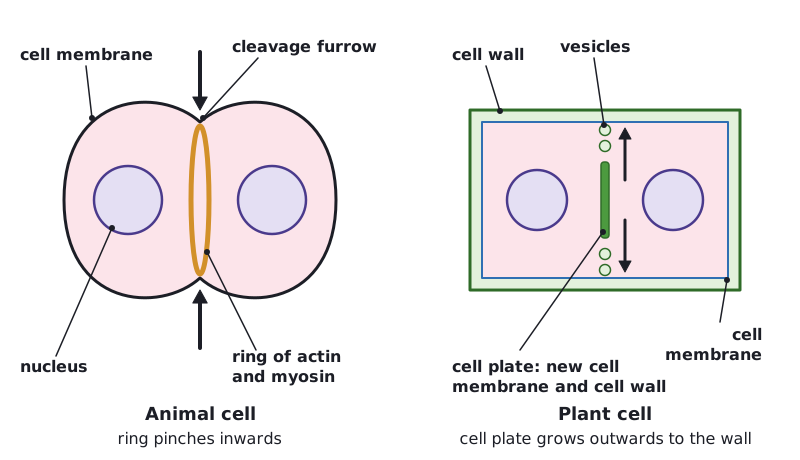
| What does the splitting | A ring of contractile actin and myosin proteins just inside the cell membrane at the equator | Vesicles that gather at the equator |
| How it happens | The ring contracts and pinches the cell membrane inwards (a cleavage furrow) until the cell is split in two | The vesicles fuse to form a cell plate, assembling sections of new cell membrane and cell wall that grow out to the existing wall |
| Direction | From the outside inwards | From the centre outwards |
 (opens full size in a new tab)
Equal and unequal cytokinesis
Division of the cytoplasm is usually, but not always, equal. Whatever the sizes, both daughter cells must receive at least one mitochondrion, and (in plant cells) plastids such as chloroplasts, plus any other organelle that can only be made by dividing a pre-existing one. A cell cannot build these from scratch.
- Oogenesis in humans: cytokinesis in both divisions of meiosis is unequal. Almost all the cytoplasm goes to the cell that becomes the ovum, which needs food reserves for the early embryo. The tiny cells produced, called polar bodies, degenerate.
- Budding in yeast: a small bud grows out of the parent yeast cell, receives a nucleus after mitosis, and then pinches off as a smaller daughter cell.
Cytokinesis is not part of mitosis. Mitosis is division of the nucleus; cytokinesis is division of the cytoplasm and usually begins in telophase.
Written and checked against the IB Biology SL specification · Updated October 2026