Natural selection as the mechanism of evolutionSpec D4.1.1, D4.1.6
In short
Natural selection is the mechanism that drives evolutionary change. Individuals with heritable traits that suit their environment survive and reproduce more, so those traits become commoner over generations. It has operated for billions of years, producing the biodiversity of life. Characteristics acquired during a lifetime are not encoded in genes, so they are not inherited.
Natural selection is the mechanism driving evolutionary change. Evolution is a change in the heritable characteristics of a population over many generations. Natural selection operates continuously in every population, and it has done so for billions of years. Its accumulated effects have produced the biodiversity of life on Earth.
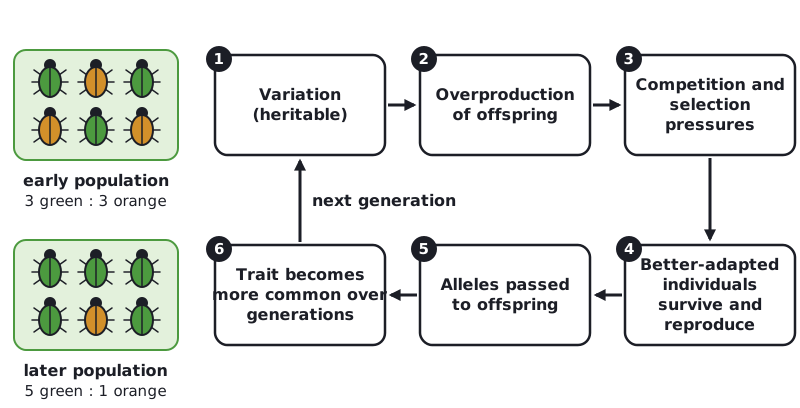
- Individuals in a population vary, and much of this variation is heritable.
- More offspring are produced than the environment can support.
- Individuals compete for limited resources and face other selection pressures.
- Individuals with traits better suited to the environment are more likely to survive and reproduce.
- They pass the alleles for these traits to their offspring.
- Over many generations, the frequency of these traits in the population rises.
 (opens full size in a new tab)
A paradigm shift
In Darwin's time it was widely understood that species evolved, but the mechanism was not clear. The leading idea was Lamarckism: organisms change during their lives through use and disuse, and pass these acquired changes on. Darwin's theory of natural selection gave a convincing mechanism and replaced Lamarckism. This is an example of a paradigm shift.
- Paradigm shift
- A fundamental change in the accepted theory and way of thinking in a field of science, when an old framework is replaced by a new one that explains the evidence better.
- Lamarckism
- The discarded idea that characteristics acquired during an organism's life, through use or disuse, are passed on to its offspring.
Traits must be heritable
Evolutionary change only happens if traits are heritable: coded in the base sequence of genes and passed on in gametes. Characteristics acquired during an individual's life due to environmental factors are not encoded in the base sequence of genes, so they are not heritable.
- Larger muscles built by training are not passed to offspring.
- A plant that grows tall in fertile soil does not produce taller offspring for that reason.
- A scar or a learned skill is not inherited.
Never write that organisms change 'because they need to'. Individuals do not evolve; populations do, as allele frequencies change over generations.
Written and checked against the IB Biology SL specification · Updated October 2026