Adaptations of plant form for harvesting light

Ecosystems (Form and function) · Ecological niches · note 6 of 7

Adaptations of plant form for harvesting lightSpec B4.2.11

In short

Plants in forests compete for light and use different strategies to reach it. Canopy trees grow tall trunks, lianas climb other trees, epiphytes grow on high branches, strangler epiphytes grow down from branches and enclose their host, and shade-tolerant shrubs and herbs photosynthesise efficiently in the dim light of the forest floor.

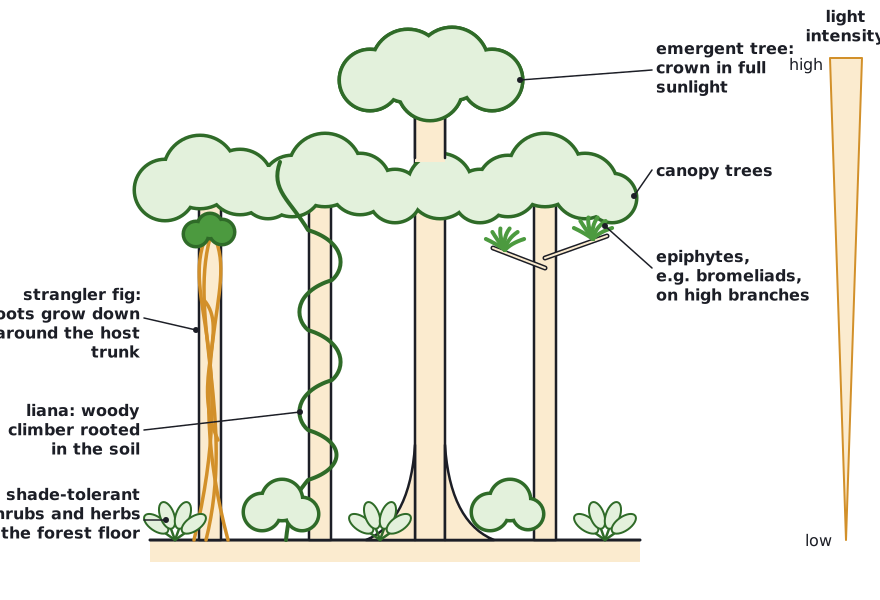
Light is the main resource plants compete for in a forest. Very little light reaches the forest floor, so each plant growth form has its own strategy to reach light sources.

Strategies for harvesting light in forests
Plant formStrategy
Trees that reach the canopyInvest in a tall, woody trunk to lift leaves above competitors into full sunlight
LianasWoody climbers rooted in the soil that use other trees for support, reaching the canopy without building a thick trunk
EpiphytesGrow on the branches of trees, high up where light is brighter, with no roots in the soil; they obtain water from rain and humid air
Strangler epiphytesStart as epiphytes on a branch, then send roots down to the soil; the roots thicken and enclose the host tree, which may die (e.g. strangler figs, Ficus)
Shade-tolerant shrubs and herbsGrow on the forest floor; large, thin leaves with a high chlorophyll content for their mass, and low respiration rates giving a low light compensation point, let them photosynthesise in dim light
Cross-section of a tropical forest: an emergent tree with its crown in full sunlight above the canopy trees, epiphytes such as bromeliads on high branches, a liana rooted in the soil climbing a trunk to the canopy, a strangler fig with roots growing down around a host trunk, and shade-tolerant shrubs and herbs on the forest floor, with light intensity falling from the canopy to the floor. (opens full size in a new tab)
Plants reach light in different ways: tall trunks, climbing, growing on branches or tolerating shade on the forest floor.
Common mistake:

Epiphytes are not parasites. They grow on trees for support and light but take no nutrients from the host.

Written and checked against the IB Biology SL specification · Updated October 2026

Frequently asked questions

What is the difference between a fundamental and a realized niche?

The fundamental niche is the potential niche of a species, based on its adaptations and tolerance limits. The realized niche is the actual extent of its niche when it is in competition with other species, so it is usually smaller. Removing a competitor often lets a species expand towards its fundamental niche.

What is the competitive exclusion principle?

The competitive exclusion principle states that two species with the same niche cannot coexist indefinitely in the same place. Competition leads either to the elimination of one species or to both being restricted to part of their fundamental niche. This is why each ecological niche in an ecosystem is unique.

What is the difference between holozoic and saprotrophic nutrition?

Holozoic nutrition, used by all animals, involves ingesting food, digesting it internally, then absorbing and assimilating the products. Saprotrophic nutrition, used by some fungi and bacteria, involves secreting enzymes onto dead organic matter, digesting it outside the cells and absorbing the products. Saprotrophs are therefore decomposers.

All 5 questions on Ecological niches