Sexual selection and Endler's guppiesSpec D4.1.7, D4.1.8
In short
Sexual selection is a selection pressure caused by competition for mates. Physical and behavioural traits that signal overall fitness, such as the plumage of male birds of paradise, increase mating success. Endler's guppy experiments controlled predation to show the balance between sexual selection for bright colour and natural selection for camouflage.
Sexual selection
Sexual selection is selection for traits that increase success in attracting a mate. Usually females choose between males, or males compete with each other. Differences in physical and behavioural traits can act as signs of overall fitness: only a healthy male in good condition can grow and display an elaborate ornament.
Male birds of paradise have brightly coloured plumage, long ornamental feathers and complex courtship displays, while females are dull brown. Females choose the males with the most impressive displays. Those males father more offspring, so alleles for elaborate plumage have increased in frequency, even though the plumage costs energy and makes the males more visible to predators.
Modelling selection: Endler's guppies
Guppies (Poecilia reticulata) live in streams in Trinidad. Males have coloured spots; females prefer more colourful males. In pools with a dangerous predator, the pike cichlid (Crenicichla), males are dull with fewer spots. In pools with only a weak predator, Rivulus, which rarely eats adults, males are bright with many spots. Endler hypothesised that colour is a balance between sexual selection and predation.
- Ten large ponds were set up in a greenhouse, five with coarse gravel and five with fine gravel, and stocked with guppies from many different streams.
- The guppies bred freely for six months with no predators.
- Predators were then added: two ponds had no predator, four had Rivulus and four had Crenicichla. The selection pressure was experimentally controlled.
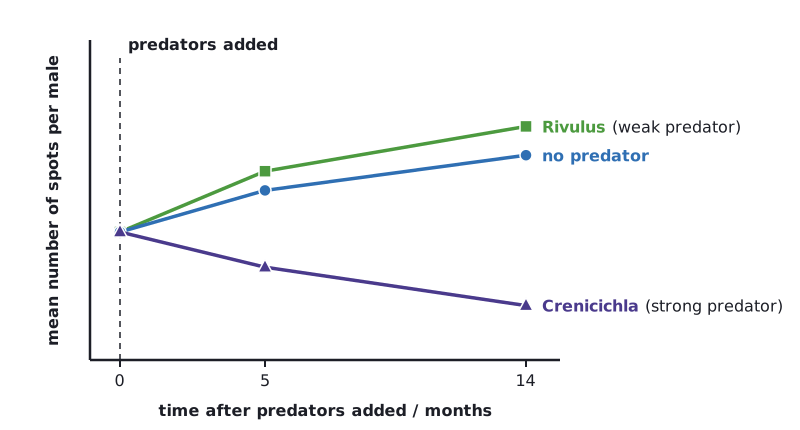
- The number and size of spots on males were recorded at the start, 5 months and 14 months after predators were added (about 10 generations).
- Spot numbers rose in ponds with no predator or with Rivulus, and fell in ponds with Crenicichla, where the spots also became smaller.
- In a field experiment, guppies moved from a high-predation site to a stream with only Rivulus had more colourful males within about two years (about 15 generations).
 (opens full size in a new tab)
With Endler-style data, name the independent variable (predation pressure), the dependent variable (spot number or size), controlled variables (pond size, gravel, food) and the replicate ponds.
Quick check
What generates new alleles?
Show answer
Mutation: a random change in the base sequence of a gene.
Why are acquired characteristics not inherited?
Show answer
They are not encoded in the base sequence of genes.
What is fitness?
Show answer
The survival value and reproductive potential of a genotype.
Written and checked against the IB Biology SL specification · Updated October 2026