
Neurons and the resting potentialSpec C2.2.1, C2.2.2
In short
Neurons are cells within the nervous system that carry electrical impulses. A cell body with the nucleus has fibres projecting from it: one long axon and many shorter dendrites. The resting potential, about −70 mV, is generated by sodium–potassium pumps using ATP to move Na⁺ out and K⁺ in, establishing and maintaining concentration gradients.
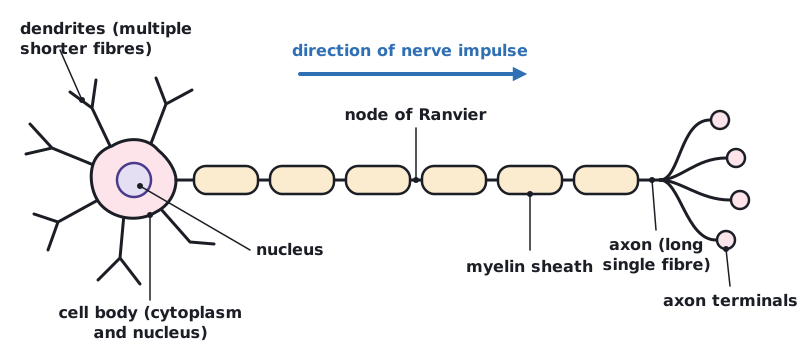
Neurons are cells within the nervous system that carry electrical impulses. The cell body contains the cytoplasm and nucleus. Elongated nerve fibres of varying length project from it.
- Axon: a long single fibre that carries impulses away from the cell body. Some are over a metre long.
- Dendrites: multiple shorter fibres that receive signals from other neurons.
- Electrical impulses are conducted along these fibres.
 (opens full size in a new tab)
The resting potential
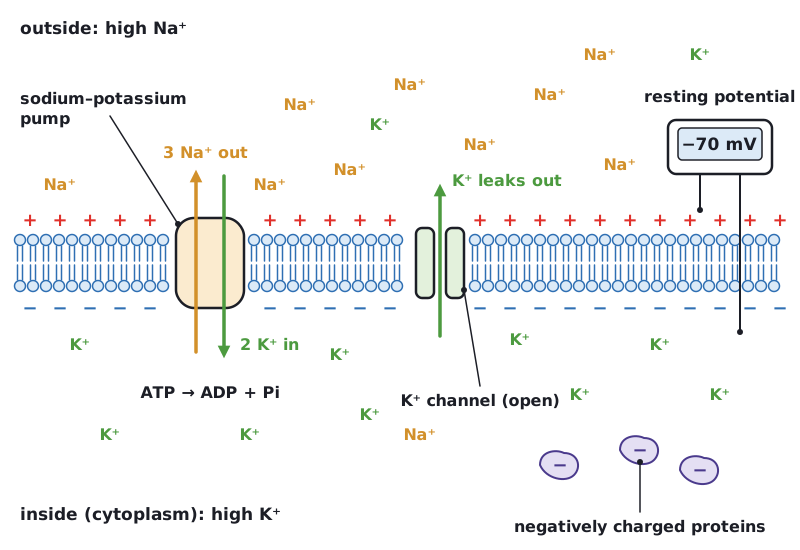
A membrane potential is the voltage across a membrane. A neuron that is not conducting an impulse is polarized: there is a charge difference across its plasma membrane, with the inside negative. This is the resting potential, typically about −70 mV.
- Sodium–potassium pumps in the plasma membrane use energy from ATP.
- Each cycle pumps three Na⁺ out of the neuron and two K⁺ in: the two ions move in opposite directions.
- This establishes and maintains concentration gradients: Na⁺ is more concentrated outside, K⁺ more concentrated inside.
- More positive charge is pumped out than in (3 Na⁺ out for 2 K⁺ in).
- The membrane is much more permeable to K⁺ than to Na⁺, so K⁺ leaks back out through open channels faster than Na⁺ leaks in.
- The cytoplasm contains many negatively charged proteins and other organic ions that cannot leave.
- Together these make the inside negative relative to the outside.
 (opens full size in a new tab)
Written and checked against the IB Biology SL specification · Updated October 2026