Directional, disruptive and stabilizing selection; artificial selectionSpec D4.1.12, D4.1.15
In short
Directional selection favours one extreme of a trait, stabilizing selection favours the intermediate and disruptive selection favours both extremes. All three result in a change in allele frequency. Artificial selection is the deliberate choice by humans of individuals with desirable traits for breeding. Antibiotic resistance is natural selection, not artificial selection.
| Type | Phenotypes favoured | Effect on the distribution | Example |
|---|---|---|---|
| Directional | One extreme | Mean shifts towards that extreme | Medium ground finches on the Galápagos after a drought: birds with deeper beaks could crack the large, hard seeds left, so mean beak depth increased. |
| Stabilizing | Intermediate values | Mean stays the same; variation decreases | Human birth mass: very light and very heavy babies historically had lower survival. |
| Disruptive | Both extremes | Variation increases; can split into two peaks | Black-bellied seedcrackers: small-billed birds feed well on soft seeds and large-billed birds on hard seeds; intermediates do neither well. |
All three types result in a change in allele frequency, because individuals with some alleles leave more offspring than others.
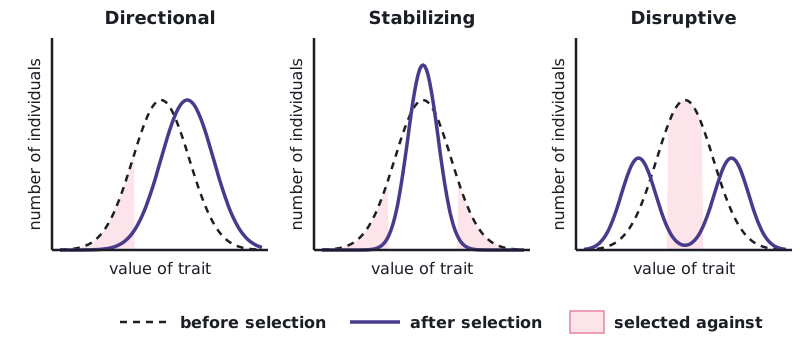 (opens full size in a new tab)
Artificial selection
Artificial selection is carried out in crop plants and domesticated animals by choosing individuals with desirable traits for breeding, generation after generation.
- Wild cabbage (Brassica oleracea) has been bred into cabbage, kale, broccoli, cauliflower and Brussels sprouts by selecting for leaves, flower heads or buds.
- Dairy cattle have been selected for high milk yield.
Antibiotic resistance in bacteria is an unintended consequence of human action. Nobody chose which bacteria would breed, so it is natural selection, not artificial selection.
Written and checked against the IB Biology HL specification · Updated October 2026