
Unity and diversity of genomesSpec A3.1.8, A3.1.9, A3.1.10
In short
The genome is all the genetic information of an organism. Members of a species share most of their genome, with some diversity from single-nucleotide polymorphisms. Eukaryote genomes vary in size, set by the total amount of DNA, and in base sequence. Variation between species is much larger than within a species, and genome size does not match complexity.
- Genome
- All the genetic information of an organism.
- Single-nucleotide polymorphism (SNP)
- A position in the base sequence of a gene or genome where individuals of a species differ in a single base.
- Genome size
- The total amount of DNA in one set of an organism's chromosomes, usually given in base pairs.
Unity and diversity within a species
Organisms in the same species share most of their genome: they have the same genes in the same order on the same chromosomes. This is the unity. Diversity comes from small differences in base sequence, mainly single-nucleotide polymorphisms (SNPs). Different versions of a gene (alleles) often differ in only one or a few bases. Any two humans have about 99.9% of their base sequence in common.
Diversity of eukaryote genomes
- Genomes vary in overall size, which is determined by the total amount of DNA.
- Genomes vary in base sequence, including which genes are present.
- Variation between species is much larger than variation within a species.
Comparing genome sizes
| Organism | Group | Genome size / million base pairs |
|---|---|---|
| Escherichia coli | bacterium (prokaryote, for comparison) | 4.6 |
| Saccharomyces cerevisiae (yeast) | fungus | 12 |
| Arabidopsis thaliana | flowering plant | 135 |
| Drosophila melanogaster (fruit fly) | insect | 180 |
| Homo sapiens (human) | mammal | 3,100 |
| Triticum aestivum (bread wheat) | flowering plant | 16,000 |
| Paris japonica | flowering plant | 149,000 |
Very simple organisms tend to have small genomes, but there is no close correlation between genome size and complexity. Some plants have genomes many times larger than the human genome. Much of a large genome is non-coding DNA, including repeated sequences, rather than extra genes. Some plants, including bread wheat and Paris japonica, are also polyploid, with several whole sets of chromosomes in each nucleus.
Comparing genome sizes
Using the table, calculate how many times larger the genome of bread wheat is than the human genome.
- Ratio = wheat genome size ÷ human genome size
- = 16,000 ÷ 3,100
- = 5.16
Answer: The wheat genome is about 5.2 times larger than the human genome.
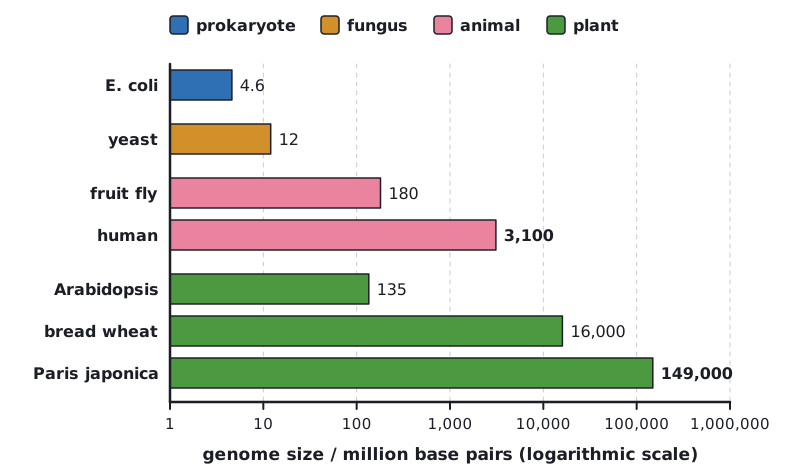 (opens full size in a new tab)
Tools: genome sizes span many orders of magnitude, so plot them on a logarithmic scale. When extracting data from a database, record the source and use the same measure (haploid size in base pairs) for every organism.
Written and checked against the IB Biology HL specification · Updated October 2026