
Fertilization in humans and hormones in IVFSpec D3.1.6, D3.1.7
In short
Fertilization in humans is the fusion of a sperm's cell membrane with the egg cell membrane, after which the sperm nucleus enters the egg and the tail and mitochondria are destroyed. Both nuclear membranes dissolve and all the chromosomes join one mitosis, producing two diploid nuclei. In IVF, normal hormone secretion is suspended and artificial hormone doses induce superovulation.
Fertilization
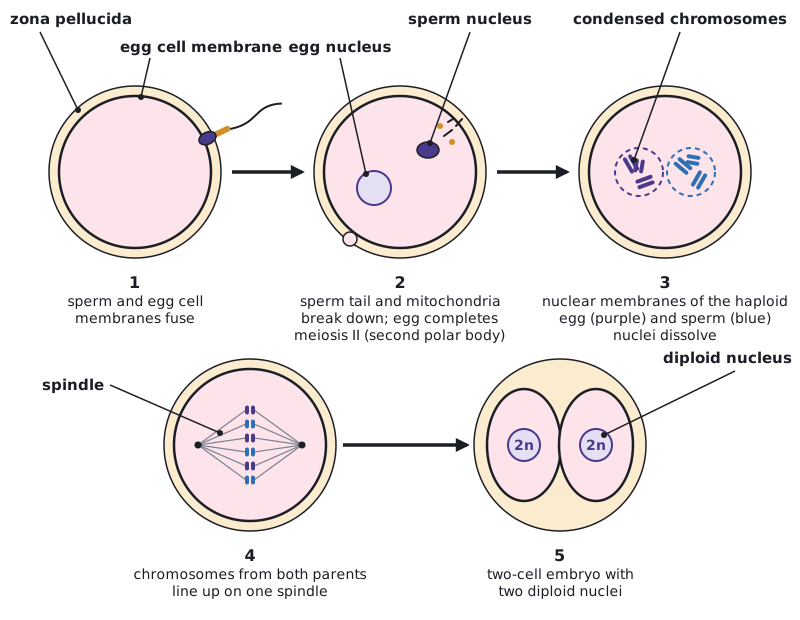
- Fertilization usually happens in the oviduct. A sperm reaches the egg and its cell membrane fuses with the egg cell membrane.
- The sperm nucleus enters the egg cytoplasm. The sperm's tail and mitochondria are destroyed, so mitochondria (and mitochondrial DNA) are inherited from the mother only.
- The egg, a secondary oocyte, completes its second meiotic division, so a haploid egg nucleus and a haploid sperm nucleus are both present in the cytoplasm.
- The nuclear membranes of the sperm and egg nuclei dissolve; the two nuclei do not fuse into one nucleus first.
- All the condensed chromosomes, from both parents, take part in a joint mitosis on one spindle. This produces two diploid nuclei, so the zygote divides into a two-cell embryo.
 (opens full size in a new tab)
Hormones in IVF
In in vitro fertilization (IVF) eggs are fertilized outside the body. Hormones are used so that many eggs can be collected at once.
- Down-regulation: a drug is given (usually daily for a few weeks) that stops the pituitary releasing FSH and LH, so the normal secretion of hormones is suspended and the woman's own cycle cannot interfere with the timing.
- Superovulation: injections of FSH (with LH activity) are given at a much higher dose than normal, so many follicles develop at once.
- When follicles are mature, an injection of hCG (which acts like LH) makes the eggs complete their maturation; they are collected from the follicles about 36 hours later.
- Eggs are mixed with sperm (or a sperm is injected into each egg) and the embryos are cultured for a few days.
- One or two embryos are transferred to the uterus. Progesterone is given to help keep the endometrium ready for implantation.
Exam tip:
For IVF, use the two key phrases: normal secretion of hormones is suspended, then artificial doses of hormones induce superovulation.
Written and checked against the IB Biology HL specification · Updated October 2026