
Photosystems and the photolysis of waterSpec C1.3.9, C1.3.10, C1.3.11
In short
Photosystems are molecular arrays of chlorophyll and accessory pigments, always located in membranes, with a special chlorophyll at the reaction centre that emits excited electrons. The array absorbs a wide range of wavelengths and funnels energy to the reaction centre; a single pigment molecule could not do this. In photosystem II, photolysis of water replaces lost electrons and releases oxygen.
Photosystems
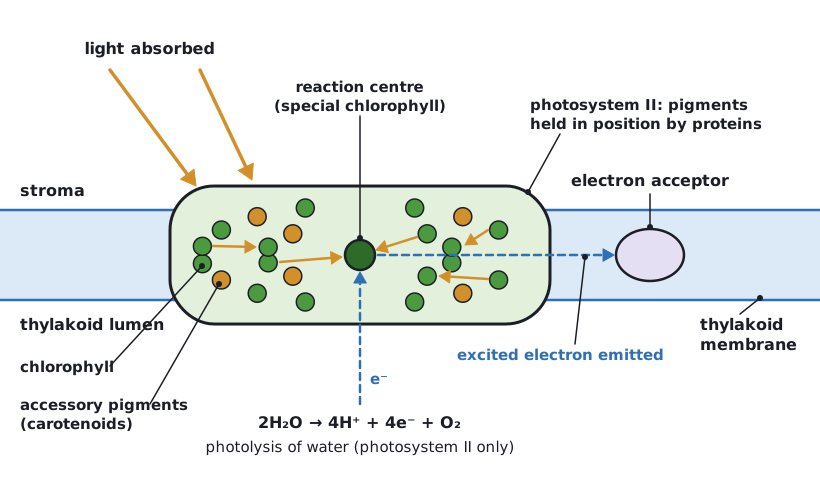
A photosystem is a molecular array of chlorophyll and accessory pigments, held in position by proteins, with a special chlorophyll at the reaction centre. Photosystems are always located in membranes: in the thylakoids of chloroplasts in photosynthetic eukaryotes, and in membranes inside cyanobacteria.
Pigment molecules around the reaction centre absorb light and pass the energy from molecule to molecule until it reaches the reaction centre chlorophyll. There an electron is excited so strongly that it is emitted and passed to an electron acceptor. There are two types: photosystem II and photosystem I.
Advantages of a structured array
- Different pigments absorb different wavelengths, so the array captures energy from a wider range of light.
- Many pigment molecules capture far more photons than one, and all their energy is funnelled to one reaction centre.
- The reaction centre is positioned next to an electron acceptor, so the excited electron is passed on instead of falling back and losing its energy as heat or light.
- A single molecule of chlorophyll or any other pigment would not be able to perform any part of photosynthesis on its own.
Photolysis of water in photosystem II
Photosystem II loses electrons from its reaction centre. They are replaced by photolysis: the splitting of water, catalysed by an enzyme complex in photosystem II on the thylakoid lumen side of the membrane.
The electrons replace those emitted by photosystem II, and the protons, released into the thylakoid lumen, add to the proton gradient used to make ATP by chemiosmosis. Both are used in photosynthesis, but oxygen is a waste product and diffuses out.
The advent of oxygen generation by photolysis, in early cyanobacteria, had immense consequences for life and geological processes on Earth. Oxygen accumulated in the oceans and atmosphere, dissolved iron was oxidised and precipitated (forming banded iron rock deposits), an ozone layer formed, and aerobic respiration became possible, while many anaerobic organisms were poisoned.
 (opens full size in a new tab)
Written and checked against the IB Biology HL specification · Updated October 2026