
Directionality: leading and lagging strandsSpec D1.1.6, D1.1.7
In short
DNA polymerases only add the 5' end of a new nucleotide to the 3' end of a growing strand, so new DNA is built in the 5' to 3' direction. At a replication fork the leading strand is therefore made continuously, from one RNA primer, while the lagging strand is made discontinuously as Okazaki fragments, each needing its own primer.
5' and 3' ends
Each nucleotide in a strand is linked to the next through its deoxyribose. The 5' terminal of a strand has a phosphate group attached to carbon 5' of the sugar; the 3' terminal has a free –OH group on carbon 3'. The two strands of the double helix are antiparallel: they run in opposite directions.
DNA polymerases add the 5' of a DNA nucleotide to the 3' end of a strand of nucleotides. The phosphate on carbon 5' of the incoming nucleotide is bonded to the 3' –OH of the strand. Free nucleotides arrive as deoxynucleoside triphosphates, and the release of two phosphates provides the energy for the bond. New DNA therefore always grows in the 5' → 3' direction.
Leading and lagging strands
| Feature | Leading strand | Lagging strand |
|---|---|---|
| Direction of synthesis relative to the fork | Same direction as the fork moves | Opposite direction to the fork |
| Type of replication | Continuous | Discontinuous, in short sections called Okazaki fragments |
| RNA primers | Needed only once, at the start | Needed repeatedly, one for each Okazaki fragment |
| Joining | Little joining: the single primer is replaced by DNA and the one nick sealed by DNA ligase | Fragments joined by DNA ligase |
Because the template strands are antiparallel and synthesis can only go 5' → 3', one new strand can follow the helicase as the fork opens, while the other must be made in short pieces backwards from the fork, each started afresh as more template is exposed.
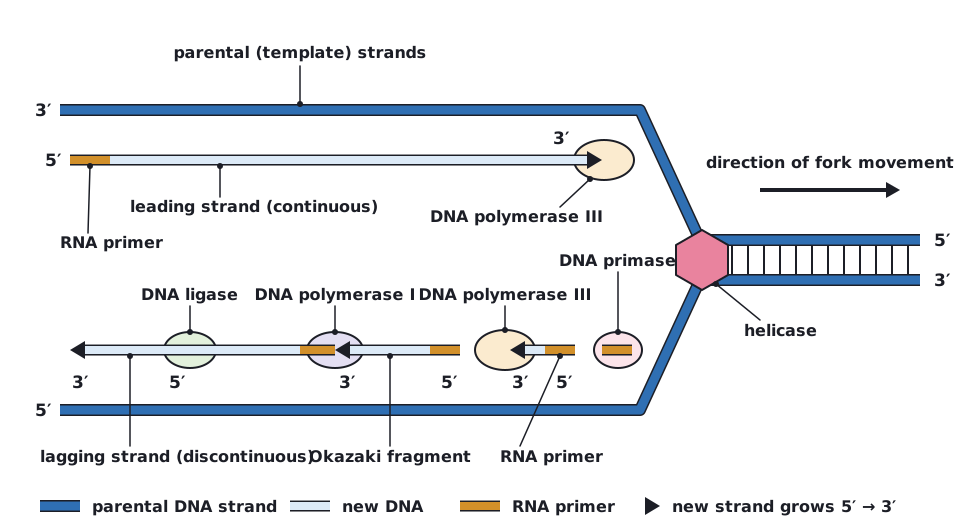 (opens full size in a new tab)
Linking question: what biological mechanisms rely on directionality? Replication, transcription and translation all proceed 5' to 3', which follows from the structure of the sugar–phosphate backbone.
Written and checked against the IB Biology HL specification · Updated October 2026