
Testing classifications and the three domainsSpec A3.2.8, A3.2.9
In short
Cladistics can test whether a traditional classification matches evolutionary relationships. In the figwort family, groups based on morphology included species that were only similar through convergent evolution, so many were moved to other families. Evidence from rRNA base sequences led in 1977 to classifying all organisms into three domains: Bacteria, Archaea and Eukarya.
Using cladistics to test classifications
If a traditional group is a true clade, the species in it should form one branch on a cladogram built from sequence data. If they are spread across different branches, the classification does not correspond to evolutionary relationships and should be revised.
The figwort family (Scrophulariaceae) is an example of the transfer of plant species between families. It was traditionally defined by flower and fruit structure and held about 275 genera and over 5,000 species. Cladograms based on chloroplast gene sequences (published around 1995–2001) showed it was not a single clade but several separate ones, so many genera were moved: snapdragons, foxgloves and speedwells to the plantain family (Plantaginaceae), and many parasitic genera to the broomrape family (Orobanchaceae); some went to new or other families. A few genera from other families, such as Buddleja, were moved in. The figwort family is now much smaller, with roughly 60 genera. The details of this case do not need to be memorised.
Nature of science: knowledge claims may eventually be falsified. Similar morphology due to convergent evolution, not common ancestry, suggested a classification that cladistics has shown to be false.
The three domains
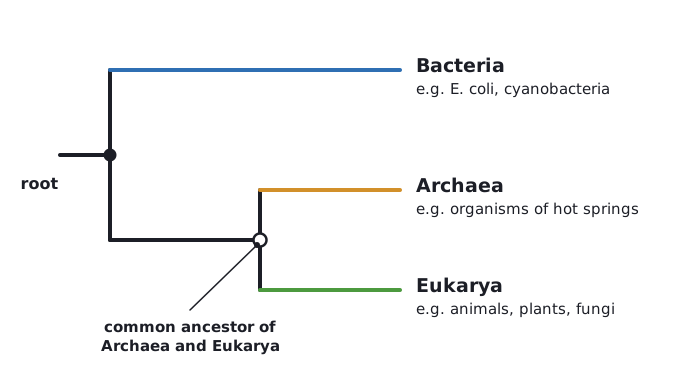
Living things used to be split into prokaryotes and eukaryotes. In 1977, base sequences of ribosomal RNA (rRNA) were compared across many organisms. rRNA is found in all cells and changes slowly, so it is suited to comparing very distantly related organisms. The results showed that prokaryotes form two groups as different from each other as either is from eukaryotes. Woese and Fox proposed this in 1977; the name "domain" for the new top level was introduced later, in 1990.
This led to the revolutionary reclassification of all organisms into three domains, an extra taxonomic level above kingdoms:
| Domain | Cell type | Examples |
|---|---|---|
| Bacteria | prokaryotic | Escherichia coli, cyanobacteria |
| Archaea | prokaryotic | many found in extreme habitats, such as hot springs and very salty water, and also in soil and oceans |
| Eukarya | eukaryotic | animals, plants, fungi and protists |
rRNA sequences also suggest that archaea are more closely related to eukaryotes than to bacteria.
 (opens full size in a new tab)
Quick check
List the traditional hierarchy of taxa from largest to smallest.
Show answer
Kingdom, phylum, class, order, family, genus, species.
What does a node on a cladogram represent?
Show answer
A hypothetical common ancestor.
What is parsimony analysis?
Show answer
Choosing the cladogram that accounts for the observed sequence variation with the smallest number of sequence changes.
Name the three domains.
Show answer
Bacteria, Archaea and Eukarya.
Why can a molecular clock only give estimates?
Show answer
Mutation rates vary with generation time, population size, intensity of selective pressure and other factors.
Written and checked against the IB Biology HL specification · Updated October 2026