Motor units in skeletal muscle

Organisms (Form and function) · Muscle and motility · note 4 of 6

Spec B3.3.4
HL only (what this means)HL only: additional Higher Level content, only for HL students. SL students can skip it. What the labels mean
Download all Muscle and motility notes (PDF)Download all notes (PDF)8 pages

Motor units in skeletal muscleSpec B3.3.4

In short

A motor unit is a single motor neuron together with all the skeletal muscle fibres it stimulates, connected by neuromuscular junctions. When the motor neuron fires, acetylcholine released at the junctions stimulates every fibre in the unit to contract together. Recruiting more motor units increases the force of a muscle contraction.

A motor unit consists of:

  • One motor neuron, whose cell body is in the spinal cord or brainstem and whose axon branches at its end.
  • The muscle fibres it controls: long, multinucleate cells packed with myofibrils.
  • Neuromuscular junctions: the synapses where each axon branch meets a muscle fibre.
  1. An action potential travels along the motor neuron to its axon terminals.
  2. At each neuromuscular junction the neurotransmitter acetylcholine is released and diffuses across the gap.
  3. It binds to receptors on the muscle fibre membrane, which depolarises and passes an impulse along the fibre.
  4. Calcium ions are released inside the fibre and the sarcomeres contract.

All the fibres in one motor unit contract at the same time. Muscles that need fine control, such as those moving the eye, have small motor units with few fibres each. Large leg muscles have large motor units. The nervous system controls the strength of contraction by changing how many motor units are active.
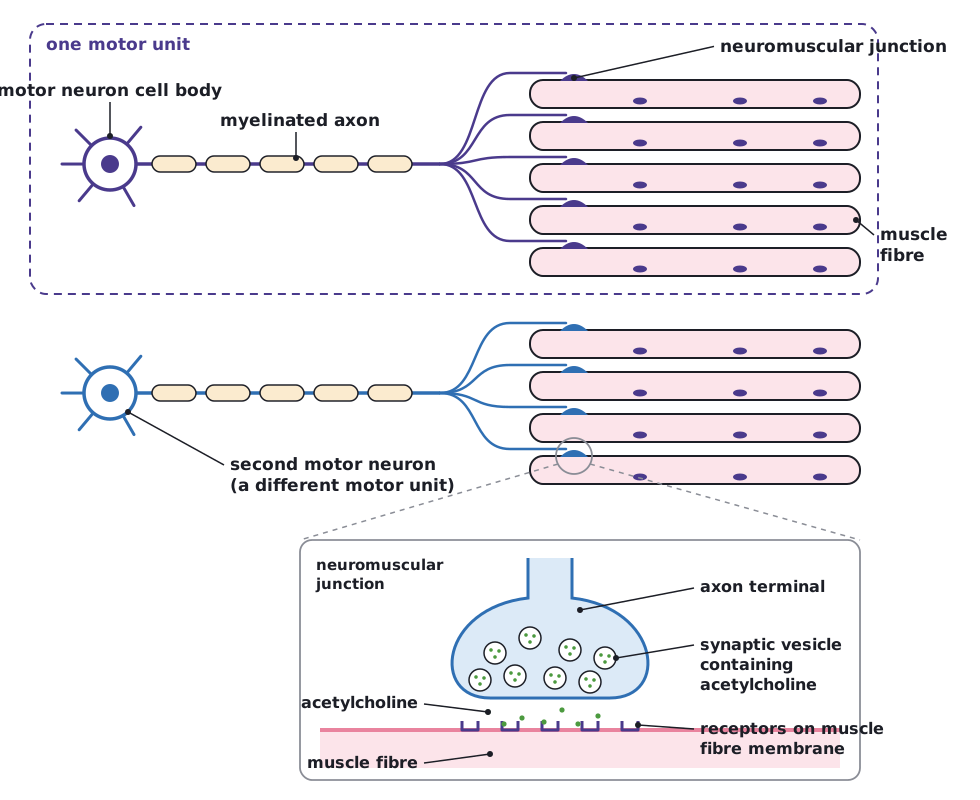
Two motor neurons, each with a cell body and myelinated axon that branches to a group of skeletal muscle fibres with a neuromuscular junction on each fibre; one neuron and its five fibres are outlined as one motor unit; an inset of one neuromuscular junction shows the axon terminal, synaptic vesicles containing acetylcholine, acetylcholine in the gap and receptors on the muscle fibre membrane. (opens full size in a new tab)
A motor unit is one motor neuron and all the muscle fibres it controls; they all contract together.

Written and checked against the IB Biology HL specification · Updated October 2026

Frequently asked questions

How does a sarcomere contract?

A sarcomere contracts when myosin heads bind to actin filaments, swivel and pull the actin towards the centre of the sarcomere, using energy from ATP. Repeated cycles of binding, pulling and detaching make the filaments slide past each other, so the Z lines move closer together and the sarcomere shortens.

Why do muscles work in antagonistic pairs?

Muscles work in antagonistic pairs because muscle tissue can only exert force when it contracts: it can pull but not push. One muscle moves a body part one way and the other moves it back, stretching the first. For example, the external and internal intercostal muscles move the ribcage in opposite directions.

What is the role of titin in muscle?

Titin is an immense, spring-like protein in each sarcomere. When the sarcomere is stretched, titin stores potential energy and then recoils, helping the sarcomere return to its resting length. It also prevents overstretching, which would pull the actin and myosin filaments apart.

All 5 questions on Muscle and motility