
Amazon deforestation as a possible tipping pointSpec D4.2.3
In short
Deforestation of the Amazon rainforest is an example of a possible tipping point in ecosystem stability. A large area of forest is needed to generate atmospheric water vapour by transpiration, which causes cooling, air flows and rainfall. Below some minimum forest area, rainfall could fail and the forest could become savannah. That minimum area is uncertain.
A tipping point is a critical threshold beyond which a small further change causes a large, often irreversible, shift to a different state.
How the rainforest makes its own rain
- Trees take up water from the soil and release huge amounts of water vapour by transpiration.
- Evaporation of this water absorbs heat, which cools the land surface.
- Rising moist air and the condensation of vapour drive air flows that draw in more moist air from the Atlantic Ocean.
- The water vapour condenses and falls as rain further inland, where it is transpired again. Water is recycled several times across the basin.
Deforestation reduces transpiration, so less rain falls and the dry season lengthens. Remaining trees become drought-stressed and fires spread more easily, killing more trees: a positive feedback. Beyond a tipping point, large parts of the forest could change to savannah.
A large area of rainforest is needed to keep these processes going, but there is uncertainty over the minimum area that is sufficient. Estimates differ between models, and climate change and fire make the threshold harder to predict.
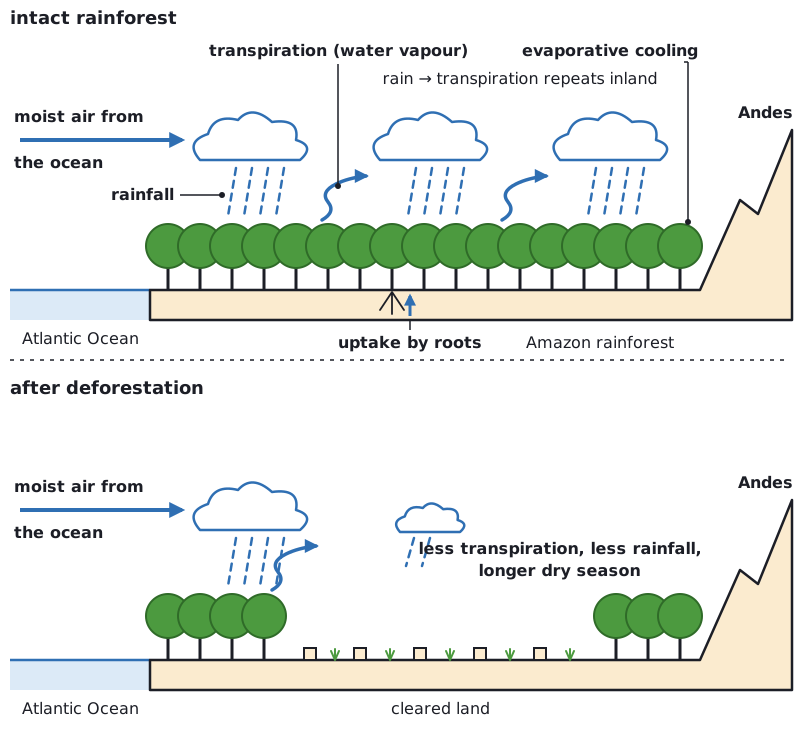 (opens full size in a new tab)
The extent of deforestation can be assessed by calculating the percentage change from the original area of forest.
Percentage change in forest area
A region originally had 4 200 000 km² of rainforest. It now has 3 486 000 km². Calculate the percentage change (practice figures).
- Change = 3 486 000 − 4 200 000 = −714 000 km²
- −714 000 ÷ 4 200 000 = −0.17
- −0.17 × 100 = −17%
Answer: −17%: the forest area has decreased by 17% of the original.
Written and checked against the IB Biology HL specification · Updated October 2026