Water transport in xylemSpec B3.2.7, B3.2.8
In short
Water moves from roots to leaves because transpiration from leaf cell walls draws water out of the xylem by capillary action, creating tension (negative pressure potential). This tension pulls the water column up, and cohesion between water molecules keeps it continuous. Xylem vessels are hollow tubes with lignified walls and pits.
- Water evaporates from the cell walls of spongy mesophyll cells and diffuses out of the leaf through stomata (transpiration).
- Water is drawn out of the xylem vessels in the leaf veins and through the cell walls to replace it, by capillary action (adhesion of water to cellulose).
- This generates tension (a negative pressure potential) in the xylem.
- The tension pulls water up the xylem from the roots.
- Cohesion between water molecules, due to hydrogen bonding, keeps the column of water continuous so it does not break.
This is the cohesion–tension mechanism. It is passive: the energy comes from evaporation, driven by heat from the sun, not from ATP.
Adaptations of xylem vessels
| Feature | Function |
|---|---|
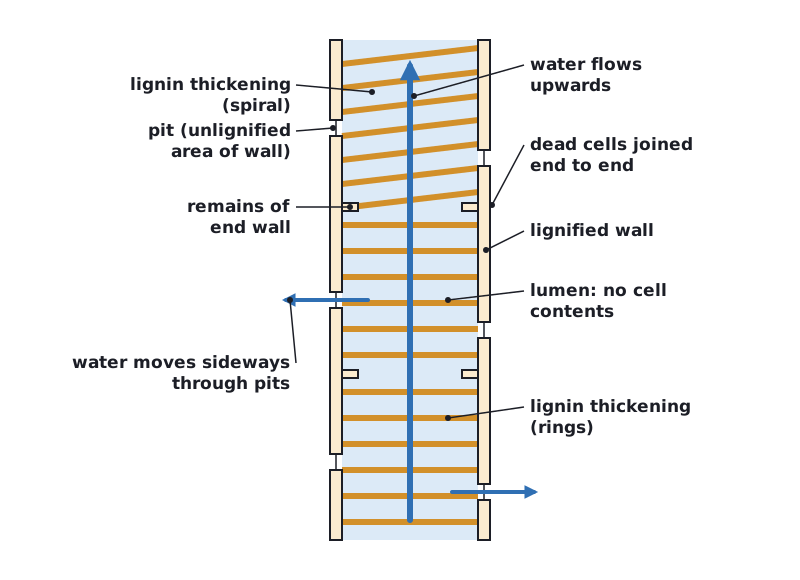
| No cell contents (dead cells, no cytoplasm or nucleus) | Unimpeded flow of water. |
| Incomplete or absent end walls | Cells form a continuous tube, so water flows without obstruction. |
| Lignified walls (thickened in rings, spirals or networks) | Withstand the tension without collapsing inwards. |
| Pits (unlignified areas of wall) | Allow water to enter and leave the vessel, and pass between neighbouring vessels. |
 (opens full size in a new tab)
Exam tip:
Linking question: how do pressure differences contribute to the movement of materials? Xylem uses negative pressure (tension); blood and phloem sap use positive pressure.
Written and checked against the IB Biology HL specification · Updated October 2026